|
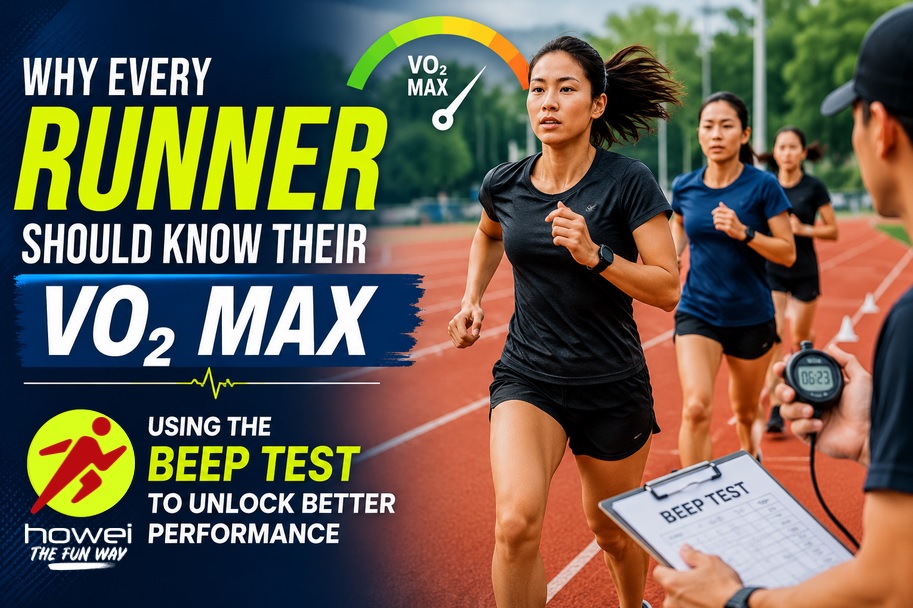
Why Every Runner Should Know Their VO₂ Max: Using the Beep Test to Unlock Better Performance
Whether you're preparing for your first 5 km, training for a marathon, or striving to improve your athletic performance, understanding your VO₂ max can provide valuable insights into your cardiovascular fitness and endurance potential. One of the simplest and most accessible ways to estimate this important fitness metric is through the 20-metre Beep Test, also known as the Multistage Fitness Test.
What is the Beep Test?
The Beep Test is an incremental shuttle run where participants run back and forth over a 20-metre course, keeping pace with audio beeps that become progressively faster. Each minute, the running speed increases, making the test increasingly challenging until the participant can no longer maintain the required pace.
Results are typically recorded as a level and shuttle number, for example Level 10 Shuttle 5 (10.5).
Because the running speed increases in a standardised manner, the final level reached can be used to estimate an athlete's aerobic capacity.
What is VO₂ Max?
VO₂ max (maximal oxygen uptake) measures the maximum amount of oxygen your body can utilise during intense exercise, expressed in millilitres of oxygen per kilogram of body weight per minute (ml/kg/min).
Simply put, it represents how efficiently your heart, lungs and muscles work together to deliver and use oxygen.
Generally:
- Higher VO₂ max = greater aerobic endurance
- Lower VO₂ max = reduced endurance capacity
Elite endurance athletes often possess exceptionally high VO₂ max values, although recreational runners can also make substantial improvements through structured training.
Estimating VO₂ Max from the Beep Test
According to the Beep Test Guide's conversion method based on the work of Flouris et al. (2005), VO₂ max can be estimated from the peak running speed reached during the test using the following equation:
VO₂ max = (Peak Running Speed × 6.65 − 35.8) × 0.95 + 0.182
The peak running speed depends on the highest level successfully completed.
The running speed for each level is calculated as:
Speed (km/h) = ((Level − 1) × 0.5) + 8.5
For example:
- Completing Level 1 corresponds to an estimated VO₂ max of approximately 16.7 ml/kg/min.
- Completing Level 10 corresponds to approximately 48.3 ml/kg/min.
- Completing Level 15 corresponds to approximately 64.1 ml/kg/min.
These values are estimates rather than laboratory measurements but provide an excellent benchmark for monitoring aerobic fitness over time.
Why VO₂ Max Matters for Runners
1. Sets Realistic Training Zones
Knowing your VO₂ max helps coaches prescribe workouts at appropriate intensities rather than relying solely on perceived effort.
Training sessions can be structured around:
- Easy aerobic runs
- Tempo runs
- Threshold workouts
- VO₂ max intervals
- Race pace sessions
This leads to more effective training while reducing the risk of overtraining.
2. Predicts Endurance Potential
Although race performance depends on many factors—including running economy, lactate threshold and mental resilience—VO₂ max provides a strong indication of endurance capacity.
A runner with a higher VO₂ max generally has greater potential to sustain faster speeds over long distances.
3. Tracks Fitness Improvements
Body weight and race times can fluctuate due to weather, terrain or race conditions. VO₂ max offers a more objective measure of cardiovascular improvement.
Retesting every 8–12 weeks allows athletes to monitor whether their aerobic fitness is improving.
4. Helps Personalise Training
Two runners with identical 10 km race times may have very different physiological profiles.
For example:
Runner A may have a high VO₂ max but poor running economy.
Runner B may have a moderate VO₂ max but excellent efficiency.
Understanding these differences allows training to target individual weaknesses rather than following a generic programme.
5. Guides Race Planning
Athletes who understand their aerobic capacity can better estimate sustainable race paces for events ranging from 5 km races to marathons.
This reduces the likelihood of starting too quickly and improves pacing consistency.
The Beep Test: More Than Just a School Fitness Test
Many people associate the Beep Test with school physical education classes, but it remains widely used by:
- Elite sporting teams
- Military organisations
- Police academies
- Fire services
- Professional coaches
- Sports scientists
Its popularity stems from being inexpensive, repeatable and requiring minimal equipment while providing a useful estimate of aerobic fitness.
Improving Your VO₂ Max
VO₂ max can be improved through consistent aerobic training. Effective methods include:
- Interval training
- High-intensity interval training (HIIT)
- Tempo runs
- Long slow distance runs
- Hill repeats
Progressive overload with adequate recovery
Improvements typically occur gradually over several weeks or months of structured training.
Beyond the Numbers
While VO₂ max is an important indicator of endurance fitness, it is only one piece of the performance puzzle.
Successful runners also develop:
- Running economy
- Lactate threshold
- Strength
- Mobility
- Nutrition
- Recovery
- Mental resilience
A recreational runner with a moderate VO₂ max but excellent pacing and consistency may outperform someone with a higher VO₂ max who lacks proper training.
Final Thoughts
The Beep Test remains one of the simplest and most accessible methods for estimating aerobic fitness. By converting your final level into an estimated VO₂ max, you gain valuable insight into your cardiovascular capacity and can make more informed training decisions.
Rather than focusing solely on finishing times, understanding your VO₂ max allows you to monitor long-term progress, train smarter and maximise your athletic potential. Whether you're preparing for your first fun run or chasing a marathon personal best, knowing your VO₂ max provides a scientific foundation for improving endurance and achieving better performance.
|

 Howei Calendar
 Results & E-Certs
 Media Gallery
 Career Opportunities
 Runfluencer Program
 Announcements
 Howei Helpdesk