Energy Estimates for Athletes: How Much Fuel Do You Really Need?
For runners, hikers, HYROX athletes and anyone who refuses to sit still
Ever finished a long run and thought:
“I’m absolutely starving. Surely I burned enough calories to eat the whole fridge?”
Or perhaps you've started training for a HYROX event, increased your weekly running mileage, added strength sessions—and suddenly your usual meals don't seem to be enough.
Understanding energy requirements can help.
Not because fitness is about obsessively counting calories, but because your body needs enough energy to run, lift, hike, recover, adapt and simply stay healthy.
The classic National Academies chapter Energy in the Recommended Dietary Allowances provides a useful foundation: energy requirements are essentially the amount of energy from food needed to balance the energy the body expends while supporting a healthy body size, composition and level of physical activity.
For today's active individual, however, we can take that concept further and apply it to running, hiking and hybrid sports such as HYROX.
Your Body Is an Energy-Burning Machine
Every day, your body spends energy in several ways.
Think of your total daily energy expenditure as having four major pieces:
1. 🛌 Resting Energy Expenditure
This is the energy your body uses simply to keep you alive.
Your heart is beating.
Your lungs are working.
Your brain is active.
Your body is maintaining temperature.
Your cells are repairing themselves.
The National Academies paper calls this resting energy expenditure (REE) and notes that it is generally the largest component of total energy expenditure unless physical activity is very high.
REE is strongly related to lean body mass. In fact, the paper notes that differences in lean body mass explain much of the variation in resting energy expenditure between people of similar age, sex, height and weight.
That is one reason two people weighing exactly 70 kg can have noticeably different energy requirements.
2. Everyday Movement
Then there is everything you do outside formal exercise.
Walking to work.
Climbing stairs.
Shopping.
Standing.
Cleaning the house.
Walking the dog.
Moving around the office.
Taking the long route to get coffee because your fitness tracker told you that you haven't hit your steps. 😆
The original National Academies paper emphasised that physical activity creates substantial variation in energy requirements and that estimating energy needs from occupation alone is inadequate because recreational activity varies so much between individuals.
This becomes especially important for active people.
A person who sits at a desk all day and does a 60-minute run is very different from someone who spends the day on their feet and then goes for the same run.
3. Exercise Energy Expenditure
Now we get to the fun bit.
Running, hiking, cycling, strength training and HYROX all add to your energy expenditure.
The 2024 Compendium of Physical Activities provides standardized MET values for different activities. For example, it lists general self-selected jogging at around 7.5 METs, running at approximately 6.5–12+ METs depending on pace, and cross-country running at 9.3 METs.
Hiking can also become surprisingly demanding.
The Compendium lists:
- Walking with a daypack on level ground: 3.5 METs
- Backpacking/hiking with a daypack: 7.8 METs
- Hill climbing at a moderate-to-brisk pace: approximately 5.3–7.0 METs, depending on gradient.
So that innocent-looking weekend hike?
It may be a serious training session.
4. The Energy Cost of Eating
Yes—even eating uses energy.
Your body expends energy digesting, absorbing and processing food. The National Academies reference describes this as the thermic effect of food, estimating it at roughly 5–10% of energy intake.
It's not the biggest component of your daily expenditure, but it is another reason why your daily energy requirement is more complicated than:
“My smartwatch says I burned 600 calories.”
So How Do We Estimate Daily Energy Needs?
A useful simplified model is:
Daily Energy Requirement ≈ Resting Energy Expenditure × Activity Factor
The National Academies approach calculates a person's resting expenditure and then applies an activity factor based on the individual's typical activity pattern.
The historical reference gives approximate activity factors around:
|
Activity pattern
|
Approximate factor
|
|
Very low activity
|
~1.3 × REE
|
|
Light activity
|
~1.5–1.6 × REE
|
|
Moderate activity
|
~1.6–1.7 × REE
|
|
Heavy activity
|
~2.0 × REE or higher
|
These are population-level estimates, not precise prescriptions for an individual. The National Academies paper itself warns that calculated energy requirements are not completely accurate for individuals and should be treated as guides for dietary planning.
And this is particularly important for athletes.
Your Running Day Is Not Your Rest Day
Imagine a recreational runner with an estimated resting requirement of:
1,600 kcal/day
On an easy day, they might have a total requirement somewhere around:
1,600 × 1.5 = 2,400 kcal
But on a much more active day:
1,600 × 1.8 = 2,880 kcal
And on an exceptionally demanding training day, their requirement could be higher still.
The important lesson isn't whether the answer is exactly 2,400 or 2,880.
It's this:
Your energy needs move with your lifestyle and training load.
The original research notes that a valid estimate should ideally represent activity across different days rather than relying on one unusually inactive or active day.
What About Hiking?
Hiking is a perfect example of why simple calorie calculators can be misleading.
Consider two hikes:
🌳 Easy 90-minute trail walk
Mostly flat.
Light backpack.
Comfortable pace.
⛰️ 4-hour mountain hike
Steep climbs.
Uneven terrain.
Heavy backpack.
Hot weather.
Minimal breaks.
They may both appear as "hiking" in an app—but they're completely different energy challenges.
Body weight matters too.
The National Academies reference notes that larger bodies generally require more energy for activities involving moving body mass over distance, with adjustments becoming particularly important for people who are both large and active.
And if you add a backpack?
The energy cost goes up further.
The Compendium even separately classifies backpacking and carrying loads because the activity demands differ.
🐦 And Then There Is HYROX...
HYROX takes the concept of energy demand to another level.
A standard HYROX race consists of:
1 km running → workout station
repeated eight times.
That's:
🏃 8 km of running
🏋️ 8 functional workout stations
The official HYROX rules describe the race as eight 1-km runs interspersed with eight workouts.
This is important nutritionally because HYROX isn't simply an 8 km running event.
You're repeatedly switching between:
Running → strength/endurance → running → strength/endurance
Your body needs to produce repeated bouts of relatively high-intensity work while continuing to move efficiently.
That's why HYROX preparation should not be treated exactly like marathon preparation—or exactly like bodybuilding.
It's a hybrid.
⚡ Why Carbohydrates Matter
Here's where energy estimation becomes more useful than simply counting calories.
Carbohydrates are a major fuel source for hard exercise.
A long-established sports nutrition consensus notes that carbohydrate is a key fuel during strenuous exercise and that inadequate carbohydrate replacement can compromise the ability to sustain training intensity.
Research and sports nutrition guidance have commonly expressed carbohydrate requirements relative to body mass—for example, approximately 5–7 g/kg/day for general training and 7–10 g/kg/day for higher endurance demands, although the appropriate amount depends on training load and individual circumstances.
So a 70 kg athlete might encounter targets such as:
70 kg × 5 g = 350 g carbohydrate/day
or during a particularly demanding endurance block:
70 kg × 7 g = 490 g carbohydrate/day
That doesn't mean every 70 kg athlete should automatically eat 490 g of carbohydrate.
It illustrates how training demand changes fuel requirements.
🥩 What About Protein?
Protein has a different job.
Think:
Carbohydrate = 🔋 Fuel
Protein = 🧱 Repair & adaptation
Fat = ⚡ Energy + essential functions
Protein helps support muscle repair and adaptation after training.
Research on endurance athletes has suggested that protein needs can rise when energy or carbohydrate intake is inadequate, while athletes with adequate energy and carbohydrate intake may have less dramatic increases in protein requirements.
This is one reason why the answer to:
"How much protein should I eat?"
shouldn't be completely separated from:
"How much am I training and how much am I eating overall?"
🚨 The Problem With Always Trying to Eat Less
Here's something particularly important for runners, hikers and HYROX athletes.
Being lighter isn't automatically better.
And eating less isn't automatically healthier.
If exercise increases but food intake doesn't increase accordingly, the body can eventually be left with insufficient energy for everything it needs to do.
This is called low energy availability (LEA).
The IOC defines energy availability as dietary energy remaining after exercise expenditure, relative to fat-free mass.
The concern is that chronically inadequate energy availability can affect health and performance.
The IOC's RED-S consensus describes problematic low energy availability as a mismatch between energy intake and exercise expenditure that leaves the body's overall needs unmet.
In other words:
You can't keep withdrawing energy from the bank without eventually affecting the account.
🏃 Signs Your Training Fuel May Not Be Keeping Up
This isn't a diagnostic checklist, but athletes should pay attention to persistent changes such as:
- Declining performance
- Unusual fatigue
- Poor recovery
- Repeated injuries
- Difficulty maintaining training quality
- Persistent hunger
- Mood changes
- Reduced ability to handle training
Low energy availability can affect both female and male athletes, and the IOC now treats RED-S as a broader athlete-health issue rather than something restricted to one sex.
If these issues persist, it's worth discussing your training and nutrition with a qualified sports dietitian or medical professional.
🔥 How Much Does a Run Actually Burn?
This is where people often get carried away with calculator numbers.
The 2024 Compendium provides MET estimates that can help characterize activity intensity, but these are estimates, not direct measurements of how many calories your particular body burned.
For example, running at:
- 6.0 mph ≈ 9.3 MET
- 6.7 mph ≈ 10.5 MET
- 7.5 mph ≈ 11.8 MET
- 8.0 mph ≈ 12.0 MET
according to the 2024 Compendium.
Two people running the same pace can still have different energy expenditures because of differences in body size, composition, efficiency, terrain and other factors.
So rather than saying:
"My 10 km run burned exactly 742 calories."
it's better to say:
"That run represented a significant additional energy demand, so I should consider its place in my overall nutrition and recovery."
That's a much healthier way to use the number.
🥾 Hiking: Don't Forget the Backpack
For hikers, the same principle applies.
A 3-hour hike with:
🎒 8 kg backpack
⛰️ significant elevation gain
☀️ hot conditions
🚶 sustained movement
can represent a very different physiological challenge from a leisurely 3-hour walk.
The Compendium lists backpacking/hiking with a daypack at 7.8 METs, illustrating how substantially the demand can rise compared with ordinary walking.
This is why experienced hikers often think about fuel and hydration as part of the equipment, just like shoes and a backpack.
🏋️ HYROX: Fueling the Hybrid Athlete
For HYROX athletes, the interesting challenge is the combination of:
🏃 Running endurance
🏋️ Strength
🔥 High-intensity work
🧠 Pacing
🔄 Repeated recovery
The official race format alternates running with functional stations eight times.
That means your training week might include:
Monday: Easy run
Tuesday: Strength
Wednesday: Recovery
Thursday: Intervals
Friday: Strength + conditioning
Saturday: Long run/hike
Sunday: Rest
Your nutritional needs shouldn't necessarily look identical every day.
📅 Think "Fuel Periodisation"
Instead of:
Same calories every day
think:
🟢 Easy day
Normal balanced meals.
🟡 Training day
More fuel to support exercise and recovery.
🟠 Long-run / long-hike day
Pay particular attention to carbohydrate, fluids and overall energy.
🔴 Hard HYROX session
Fuel before, during where appropriate, and after training.
🔵 Recovery day
Continue eating well—recovery doesn't stop when the workout ends.
This is one of the most useful ways to think about energy requirements.
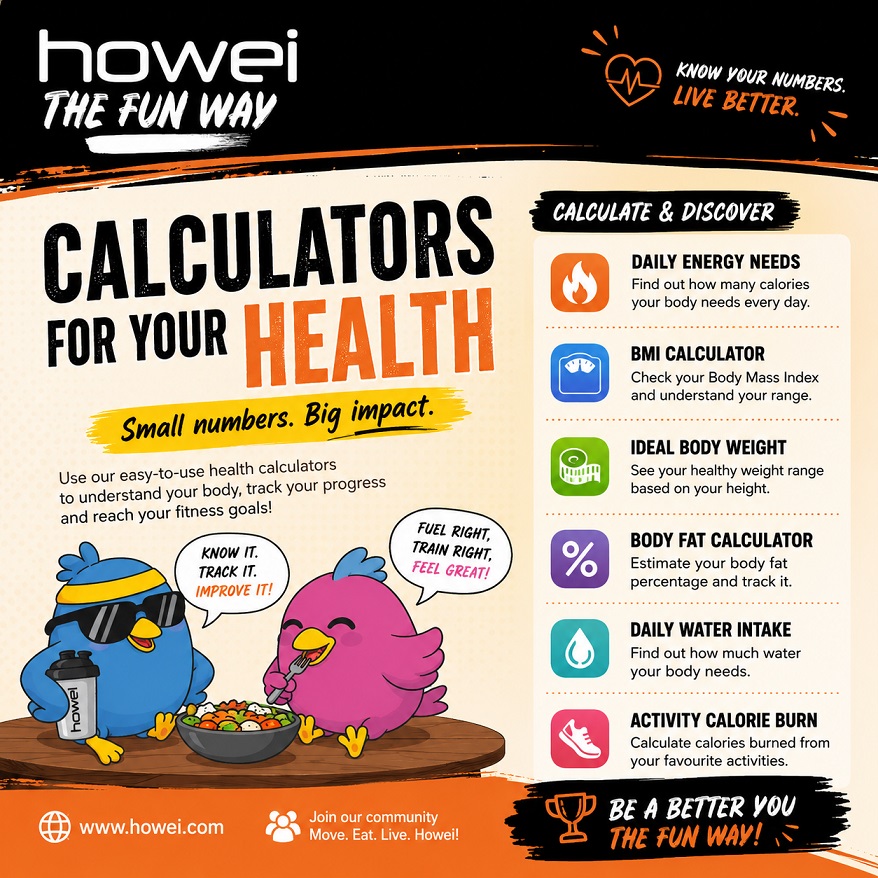
🧮 A Better Howei Health Calculator
If you're building a "Calculators for Your Health" feature for Howei, I'd recommend that the calculator doesn't simply output:
"Your daily requirement = 2,486 kcal."
Instead, make it educational.
STEP 1 — Estimate resting needs
Use:
STEP 2 — Understand activity
Ask about:
- Daily steps/activity
- Running
- Hiking
- Strength training
- HYROX/functional training
- Other sports
- Training frequency
- Typical session duration
STEP 3 — Estimate total daily energy needs
Present a range, rather than false precision.
For example:
Estimated daily energy requirement
2,400–2,700 kcal/day
STEP 4 — Show training-day variation
🟢 Rest day: ~2,300 kcal
🟡 Run day: ~2,500 kcal
🔴 Long run/HYROX day: ~2,700+ kcal
The exact values would be calculated from the individual's inputs.
STEP 5 — Explain what the number means
"This is an estimate—not a prescription."
That final sentence is extremely important.
The original National Academies reference explicitly recognises that calculated energy requirements are imperfect estimates for individuals.
🧠 The Most Important Number Isn't Always Calories
For an active person, I would encourage looking at several numbers together:
|
Number
|
What it tells you
|
|
⚡ Energy
|
How much fuel you may need
|
|
🏃 Training volume
|
How much work you're doing
|
|
🍚 Carbohydrate
|
Fuel availability for harder exercise
|
|
🥩 Protein
|
Recovery and adaptation support
|
|
💧 Fluid
|
Hydration needs
|
|
❤️ Resting HR
|
Possible recovery/training signal
|
|
😴 Sleep
|
Recovery capacity
|
|
⏱️ Performance
|
Whether training is working
|
|
⚖️ Body weight
|
One trend—not the whole story
|
The goal isn't to make people obsessed with numbers.
It's to help them understand the relationship between numbers and how they feel and perform.
🐦 The Howei Philosophy: Know Your Numbers. Don't Become Your Numbers.
This is where Howei's "Calculators For Your Health" concept becomes particularly useful.
A calculator can tell you:
"Here's an estimate."
But it shouldn't tell you:
"Here's what you MUST eat."
Your body isn't a spreadsheet.
Your training isn't always predictable.
Your sleep changes.
Your stress changes.
Your work changes.
Your weekend hike might suddenly become a 6-hour adventure.
And your HYROX session might absolutely destroy the legs you thought were indestructible. 😂
The numbers are there to help you make better decisions, not to control you.
🧡 The Better-Fitter-You Formula
For runners, hikers and HYROX athletes, think about your fitness like this:
FUEL 🔋
Give your body enough energy.
MOVE 🏃
Challenge your cardiovascular system.
LIFT 🏋️
Build strength and resilience.
RECOVER 😴
Allow your body to adapt.
TRACK 📊
Measure meaningful trends.
ADJUST 🔄
Change your training and nutrition as your workload changes.
ENJOY 😎
Because sustainable fitness should actually be fun.
🏁 The Takeaway
The fundamental idea from the National Academies' energy chapter is surprisingly simple:
Your energy requirement reflects the energy your body spends.
But for an active person, that number isn't fixed.
A sedentary Monday, a 10 km Tuesday run, a Thursday HYROX session and a Saturday mountain hike can create very different energy demands.
The science therefore gives us a starting point—not a perfect answer.
For athletes, the smarter question isn't:
❌ "How many calories should I eat?"
It's:
✅ "How much energy do I need to support the way I live, train, recover and perform?"
And that is exactly where a good health calculator can help.
Know your numbers.
Understand your body.
Fuel your training.
Recover properly.
Keep moving.
🐦 Become a better, fitter YOU — the Howei way.
A note on the science
The linked NCBI chapter is from the 10th edition of the Recommended Dietary Allowances, published in 1989, so it is best treated as a foundational explanation of energy expenditure rather than a modern athlete-specific nutrition guideline. For current sports practice, I have therefore supplemented its framework with the 2024 Compendium of Physical Activities, current IOC RED-S consensus guidance and sports-nutrition literature.
For an individual athlete, particularly someone undertaking high-volume endurance or HYROX training, these calculations should be considered estimates rather than medical or dietary prescriptions. Persistent fatigue, declining performance, recurrent injury or suspected under-fuelling warrants assessment by an appropriately qualified sports dietitian or healthcare professional.
|

 Howei Calendar
 Results & E-Certs
 Media Gallery
 Career Opportunities
 Runfluencer Program
 Announcements
 Howei Helpdesk